
Rotary Press UV Lamp Systems Explained | Industrial Printing Applications
Learn how rotary press UV lamp systems support high-speed industrial printing through reliable curing performance, production efficiency and equipment compatibility.
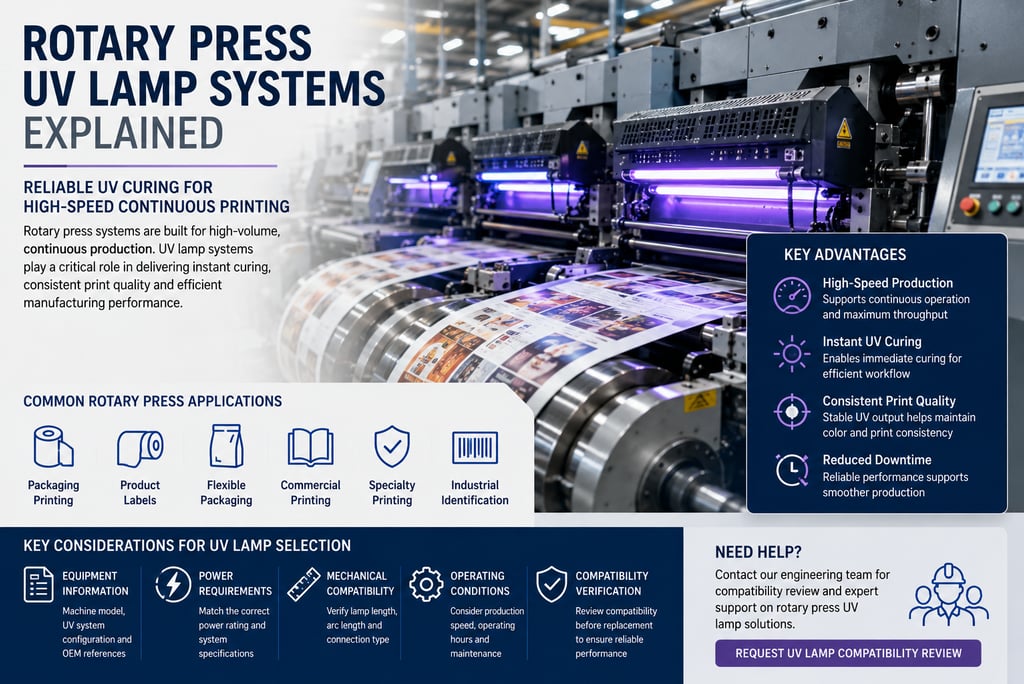
Rotary Press UV Lamp Systems Explained
Understanding UV Systems in High-Speed Continuous Printing Applications
Rotary press systems are widely used in industrial printing environments where high production volumes, continuous operation and consistent print quality are critical requirements. From packaging materials and product labels to commercial printing and specialty applications, rotary press technology continues to support large-scale manufacturing operations around the world.
As production speeds increase and workflow efficiency becomes increasingly important, UV systems play a significant role in maintaining reliable printing performance. Understanding how UV systems integrate with rotary press equipment can help manufacturers make informed decisions regarding maintenance, replacement planning and long-term operational reliability.
This article explores the role of UV lamp systems in rotary press applications and the key considerations associated with these production environments.
What Is a Rotary Press System?
A rotary press is a printing system that transfers images using rotating cylinders while continuously feeding material through the press.
Unlike sheet-fed printing systems, rotary presses are designed for continuous operation and are commonly used for high-volume production.
Key characteristics include:
Continuous printing operation
High production throughput
Consistent print quality
Efficient manufacturing workflows
Large-volume production capability
Because rotary press systems are often expected to operate for extended production runs, equipment reliability becomes a critical operational factor.
Common Rotary Press Applications
Rotary press technology supports a wide range of industrial printing applications.
Typical examples include:
Packaging Printing
Product Labels
Flexible Packaging
Commercial Printing
Specialty Printing
Industrial Identification Materials
Many of these applications require consistent curing performance to support reliable production quality throughout extended manufacturing runs.
For organizations involved in label production, many of the same operational considerations can also be found in Label Printing UV Lamp Applications.
Why UV Systems Are Used in Rotary Press Equipment
Rotary press systems frequently operate at production speeds where efficient curing becomes an important part of the manufacturing process.
UV systems are integrated into printing equipment to support the curing of inks and coatings during production.
This approach helps support:
Continuous manufacturing operations
Production efficiency
Print consistency
Workflow optimization
Reliable equipment performance
As production demands increase, maintaining stable curing performance becomes increasingly important.
High-Speed Production and UV Performance
One of the defining characteristics of rotary press equipment is production speed.
Unlike lower-volume printing environments, rotary presses are often expected to maintain consistent output over extended periods of operation.
In these environments, manufacturers typically focus on:
Production stability
Consistent curing performance
Equipment reliability
Process repeatability
Reliable UV system performance contributes directly to these operational objectives.
Rotary Press Applications in Packaging Production
Packaging remains one of the most important sectors utilizing rotary press technology.
Packaging manufacturers often require:
High-volume production capability
Consistent visual quality
Efficient production workflows
Reliable manufacturing performance
UV systems help support these requirements by integrating curing processes directly into the production workflow.
Organizations interested in broader printing applications may also find value in Understanding UV Systems in Offset Printing Applications.
Operational Considerations for Rotary Press UV Systems
Successful operation depends on more than simply installing replacement lamps.
Several factors influence long-term system performance.
Equipment Configuration
Understanding machine specifications remains an important part of maintenance and replacement planning.
Useful information may include:
Machine manufacturer
Machine model
Existing UV system configuration
OEM references
Production Requirements
Production schedules and operating conditions often influence maintenance planning and replacement decisions.
Factors may include:
Daily operating hours
Production volume
Application requirements
Maintenance schedules
System Maintenance
Regular maintenance practices contribute to stable UV system performance and long-term equipment reliability.
Maintaining proper operating conditions can help support consistent production quality over time.
Evaluating Replacement UV Lamps
Over time, replacement lamps may be required as part of normal equipment maintenance.
When evaluating replacement solutions, manufacturers often review:
Existing lamp specifications
OEM references
Equipment requirements
Mechanical compatibility
Application requirements
A structured review process can help reduce uncertainty before implementation.
Organizations evaluating replacement options may also benefit from reviewing Understanding UV Lamp Compatibility for Industrial Equipment.
Why Compatibility Verification Matters
Rotary press systems are typically designed around specific equipment configurations and operating requirements.
As a result, replacement decisions should not rely solely on matching dimensions or power ratings.
Compatibility assessments may consider:
OEM specifications
Equipment configuration
Installation requirements
Operating conditions
Application objectives
Reviewing these factors before replacement can help support more reliable equipment operation.
For a practical overview of compatibility evaluation procedures, see How to Verify UV Lamp Compatibility with OEM Exposure Systems.
Understanding Power Requirements
Industrial printing systems may operate using various lamp power configurations depending on equipment design and production requirements.
Understanding power requirements remains an important part of replacement planning.
Manufacturers evaluating replacement solutions may also benefit from reviewing Understanding UV Lamp Power Ratings for Industrial UV Systems.
The Role of UV Systems in Modern Printing Operations
As manufacturers continue to seek greater efficiency and production consistency, UV systems remain an important component of rotary press operations.
The ability to support continuous production, stable curing performance and efficient workflows continues to make UV technology a valuable part of modern industrial printing environments.
For many facilities, UV systems represent a critical element in maintaining reliable manufacturing performance.
Conclusion
Rotary press systems are designed for high-volume, continuous printing operations where production efficiency and consistent performance are essential requirements.
Understanding how UV systems support these environments helps manufacturers make informed decisions regarding maintenance, replacement planning and long-term operational reliability.
By evaluating equipment requirements, compatibility considerations and operational conditions, organizations can better support reliable printing performance throughout the life of the system.
Need Help Evaluating UV Lamp Compatibility?
If you are evaluating a replacement UV lamp for a rotary press system, a structured compatibility review can help assess equipment requirements before implementation.
Request a UV Lamp Compatibility Review to discuss your machine model, OEM references or existing lamp configuration.
XLEADTECH supports industrial UV applications including rotary press systems, offset printing, label printing, exposure systems and industrial UV curing processes through application-focused engineering assistance and compatibility review services.