Understanding UV Lamp Compatibility for Industrial Equipment
Learn the key factors affecting UV lamp compatibility for industrial equipment, including OEM specifications, lamp power, dimensions and application requirements.
Understanding UV Lamp Compatibility for Industrial Equipment
Why Compatibility Matters When Replacing UV Lamps
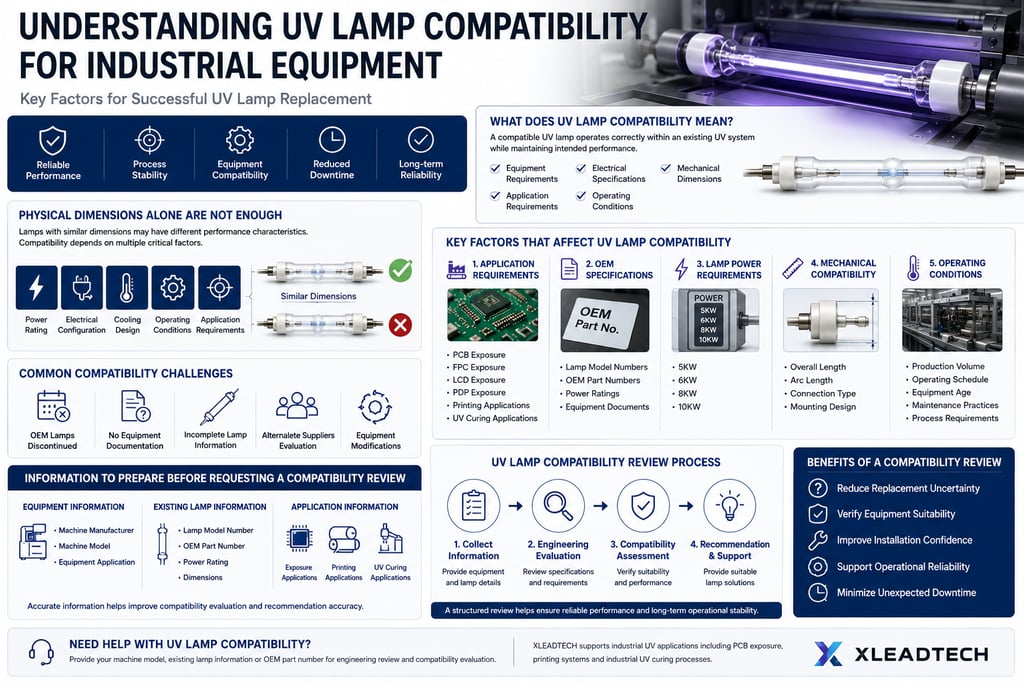
Replacing an industrial UV lamp involves more than matching physical dimensions. Compatibility affects equipment performance, process stability and long-term operational reliability.
In many cases, equipment owners are faced with discontinued lamp models, unavailable OEM parts or incomplete technical documentation. Understanding compatibility requirements helps reduce risk and supports successful replacement projects.
This guide outlines the key considerations when evaluating UV lamp compatibility for industrial equipment.
What Does UV Lamp Compatibility Mean?
UV lamp compatibility refers to the ability of a replacement lamp to operate correctly within an existing UV system while maintaining intended performance characteristics.
A compatible UV lamp should align with:
Equipment requirements
Electrical specifications
Mechanical dimensions
Application requirements
Operating conditions
Compatibility should always be evaluated as a complete system consideration rather than a simple dimensional comparison.
Why Physical Dimensions Alone Are Not Enough
One of the most common mistakes during UV lamp replacement is assuming that lamps with similar dimensions are interchangeable.
While dimensions are important, other factors significantly influence compatibility.
These include:
Power rating
Electrical configuration
Cooling design
Equipment operating conditions
Application requirements
Selecting a lamp based solely on physical size may lead to reduced performance or operational issues.
Key Factors That Affect UV Lamp Compatibility
1. Application Requirements
Different industrial processes require different UV performance characteristics.
Common applications include:
PCB Exposure
FPC Exposure
LCD Exposure
PDP Exposure
Label Printing
Offset Printing
Rotary Press Printing
Industrial UV Curing
Understanding the intended application is often the first step in compatibility evaluation.
2. OEM Specifications
OEM specifications provide valuable information regarding original equipment requirements.
Examples include:
Lamp model numbers
OEM part numbers
Power ratings
Equipment documentation
Whenever available, OEM references help simplify compatibility assessment.
3. Lamp Power Requirements
Industrial UV systems may operate at different power levels depending on equipment design and process requirements.
Typical industrial configurations may include:
5KW
6KW
8KW
10KW
Using an incorrect power configuration may affect process performance and equipment reliability.
4. Mechanical Compatibility
Mechanical compatibility includes:
Overall lamp length
Arc length
Connection configuration
Mounting arrangement
Accurate dimensional information helps verify installation suitability.
5. Operating Conditions
Environmental and operating conditions should also be considered.
Factors include:
Production volume
Operating schedule
Equipment age
Maintenance practices
Process requirements
Understanding these conditions helps identify suitable replacement options.
Common Compatibility Challenges
Compatibility reviews are often requested when:
OEM lamps are discontinued
Equipment documentation is unavailable
Existing lamp information is incomplete
Alternative suppliers are being evaluated
Equipment modifications have occurred over time
Engineering review can help clarify compatibility requirements before replacement decisions are made.
Information to Prepare Before Requesting a Compatibility Review
To support an effective compatibility assessment, prepare the following information whenever possible:
Equipment Information
Machine manufacturer
Machine model
Equipment application
Existing Lamp Information
Lamp model number
OEM part number
Power rating
Dimensions
Application Information
Exposure application
Printing application
Industrial UV curing application
Providing accurate information helps improve compatibility evaluation and recommendation accuracy.
Benefits of a Compatibility Review
A compatibility review helps:
Reduce replacement uncertainty
Verify equipment suitability
Improve installation confidence
Support operational reliability
Minimize unexpected downtime
For industrial UV systems, compatibility assessment is often one of the most important steps before selecting replacement lamps.
Conclusion
UV lamp compatibility involves more than matching dimensions. Application requirements, OEM specifications, lamp power and equipment operating conditions all contribute to successful replacement decisions.
A structured compatibility review helps equipment owners identify suitable UV lamp solutions while supporting reliable performance and long-term operational stability.
Need Help With UV Lamp Compatibility?
Provide your machine model, existing lamp information or OEM part number for engineering review and compatibility evaluation.
XLEADTECH supports industrial UV applications including PCB exposure, printing systems and industrial UV curing processes through application-focused compatibility review services.
Looking for a replacement UV exposure lamp?
Review our UV Lamp Replacement Guide before starting a compatibility evaluation.