UV Lamp Replacement Guide for Industrial UV Systems
Learn key considerations for industrial UV lamp replacement, including compatibility requirements, OEM-compatible solutions, application evaluation, and replacement planning.
UV Lamp Replacement Guide
Understanding Industrial UV Lamp Replacement Requirements
Industrial UV systems are often designed for long operating lifecycles, with many installations remaining in production for years. Over time, UV lamps become consumable components that require replacement to maintain process consistency and production reliability.
Whether the application involves PCB exposure, printing, packaging, or industrial UV curing, selecting a replacement lamp involves more than identifying a matching part number.
This guide outlines key considerations that can help manufacturers evaluate replacement requirements before implementation.
When Should a UV Lamp Be Replaced?
Replacement intervals vary depending on application requirements, operating conditions, maintenance practices, and production objectives.
Common reasons for replacement include:
Reduced UV output
Inconsistent curing or exposure performance
Production quality issues
Lamp aging
Planned preventive maintenance
Equipment refurbishment projects
In some applications, lamps may continue operating even after UV performance has declined below process requirements. Monitoring production quality and maintenance history can help determine appropriate replacement timing.
Information Required Before Evaluating a Replacement
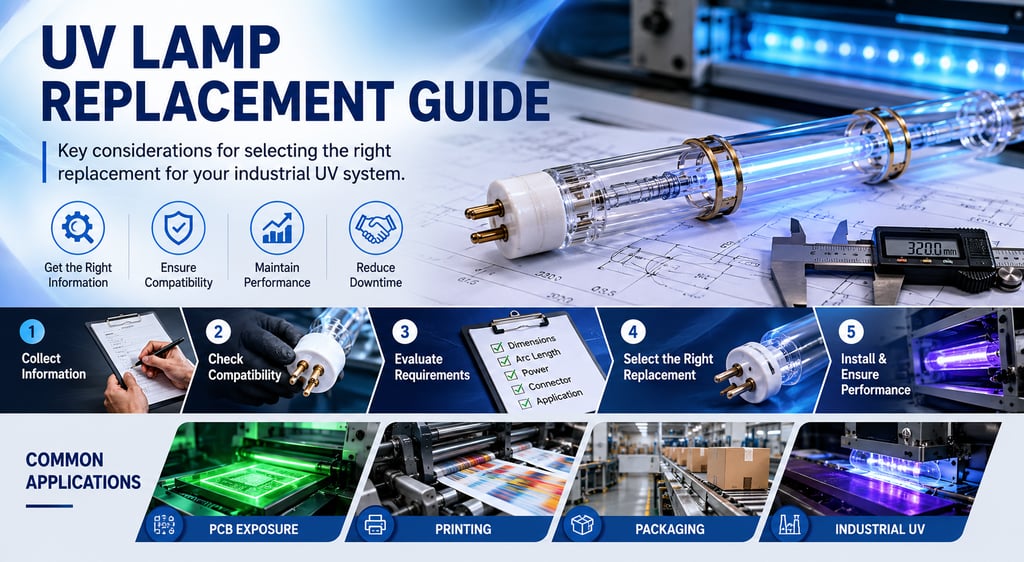
Before reviewing replacement options, it is useful to collect as much information as possible about the existing installation.
Common reference information includes:
Existing lamp dimensions
Arc length
Operating power
Electrical configuration
Connector type
Equipment model information
Existing lamp markings
Installation photographs
Providing complete technical information can help simplify compatibility evaluation and manufacturing review.
Dimensions Are Only One Part of Compatibility
One of the most common assumptions in replacement projects is that a lamp with matching dimensions will automatically provide equivalent performance.
In practice, compatibility may involve additional considerations.
Depending on the application, factors such as operating power, electrical characteristics, cooling conditions, reflector design, and production requirements may influence overall system performance.
For this reason, replacement projects often benefit from reviewing application requirements before manufacturing decisions are made.
Learn more about our Engineering Support for UV Systems.
Common Industrial UV Applications
Industrial UV technology is used across a variety of manufacturing environments.
While replacement requirements differ between industries, many projects share similar compatibility and operational considerations.
PCB Exposure Systems
Exposure applications require stable UV performance and consistent operating conditions to support manufacturing accuracy and process repeatability.
For exposure-related applications, customers may also review our UV Exposure Lamps solutions.
Printing and Packaging
Commercial printing, label production, and packaging environments often require reliable UV performance to support production efficiency and curing consistency.
Replacement planning may involve evaluating operating conditions and equipment requirements before implementation.
Industrial UV Applications
Industrial UV systems are used in coating, manufacturing, and processing environments where maintenance planning and operational reliability are important considerations.
Replacement requirements may vary depending on equipment design and production objectives.
Evaluating OEM-Compatible Replacement Options
Many industrial UV systems remain in operation long after initial installation.
As equipment ages, organizations may evaluate OEM-compatible replacement options to support maintenance planning, sourcing flexibility, and long-term operational requirements.
When reviewing replacement options, it is often helpful to consider:
Existing system requirements
Application conditions
Operating characteristics
Maintenance objectives
Long-term production requirements
A structured compatibility review can help identify important considerations before replacement decisions are made.
Learn more about our OEM Compatible UV Lamp Solutions.
Custom Manufacturing Considerations
Not every replacement project aligns with a standard specification.
Depending on the application, custom manufacturing may be required to support specific dimensions, electrical configurations, operating characteristics, or installation requirements.
Typical considerations may include:
Custom lamp dimensions
Arc length requirements
Electrical configuration requirements
Connector options
Application-specific manufacturing considerations
Understanding these requirements early in the project can help support more effective planning and implementation.
UV Lamp Replacement Checklist
Before beginning a replacement project, consider gathering the following information:
✓ Existing lamp photographs
✓ Lamp dimensions
✓ Arc length information
✓ Operating power specifications
✓ Connector information
✓ Equipment details
✓ Application information
✓ Available technical documentation
Having this information available can help streamline compatibility evaluation and technical discussions.
Need Help Evaluating a Replacement Project?
Industrial UV replacement projects often involve application-specific requirements that extend beyond dimensional matching alone.
Whether you are reviewing an existing installation, evaluating OEM-compatible options, or planning a custom manufacturing project, a structured review can help identify compatibility considerations before implementation.
Start with a Compatibility Review to discuss your project requirements.