
How to Verify UV Lamp Compatibility with OEM Exposure Systems
Learn how to verify UV lamp compatibility with OEM exposure systems for PCB, FPC, LCD and PDP applications. Understand key factors including OEM specifications, power requirements and equipment configuration.
How to Verify UV Lamp Compatibility with OEM Exposure Systems
A Practical Approach for PCB, FPC, LCD and PDP Exposure Equipment
Replacing a UV lamp in an exposure system is often assumed to be a straightforward task. In reality, compatibility evaluation is one of the most critical steps in maintaining exposure performance, process stability and production consistency.
Many manufacturers eventually face situations where original OEM lamps become difficult to source, lead times increase, or replacement costs become difficult to justify. While alternative solutions may be available, verifying compatibility requires more than simply matching lamp dimensions or power ratings.
For exposure applications used in PCB, FPC, LCD and PDP manufacturing, even small differences in lamp characteristics can influence production results. Understanding what should be evaluated before replacement can help reduce risk and support a smoother transition.
Why Compatibility Verification Matters
Exposure systems are designed as complete operating environments rather than collections of independent components.
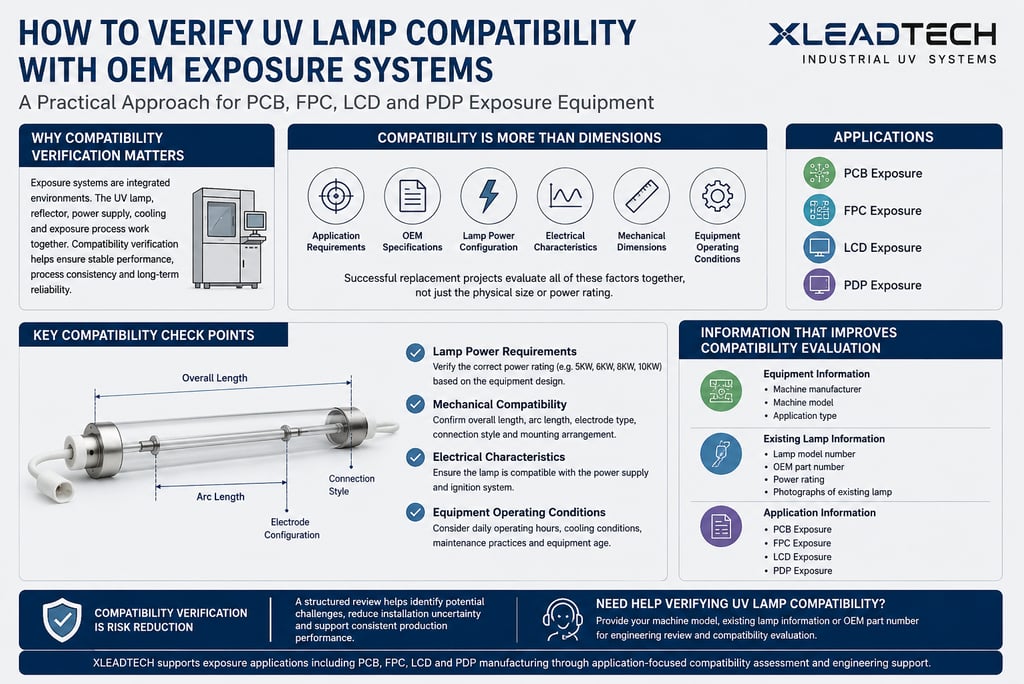
The UV lamp, reflector system, power supply, cooling arrangement and exposure process are all interconnected. Replacing a lamp without understanding these relationships may result in changes to exposure performance, maintenance requirements or production consistency.
Compatibility verification helps determine whether a replacement lamp can operate within the intended system conditions while supporting the application's performance requirements.
Compatibility Is More Than Physical Dimensions
One of the most common misconceptions is that a lamp with the same overall length and power rating will automatically perform as a suitable replacement.
Physical dimensions are important, but they represent only one part of the evaluation process.
A proper compatibility review should consider:
Application requirements
OEM specifications
Lamp power configuration
Electrical characteristics
Mechanical dimensions
Equipment operating conditions
Successful replacement projects typically evaluate all of these factors together rather than relying on dimensional matching alone.
Start with the Application
Before reviewing lamp specifications, it is important to understand the exposure process itself.
Exposure systems used in:
PCB Manufacturing
FPC Manufacturing
LCD Production
PDP Production
are designed to support precise and repeatable exposure conditions.
The first question should not be:
"Which lamp fits the machine?"
Instead, it should be:
"What exposure process is the machine designed to perform?"
Understanding the application establishes the foundation for evaluating compatibility.
Review Available OEM Information
OEM information remains one of the most valuable references during a compatibility assessment.
Useful information may include:
OEM part numbers
Lamp model references
Machine manufacturer
Machine model
Equipment documentation
Even partial information can significantly improve the accuracy of compatibility verification.
In many cases, equipment owners may no longer have complete documentation. When this occurs, photographs, existing lamp markings and machine details can often provide useful starting points.
Verify Lamp Power Requirements
Power rating is one of the most important specifications to confirm during a replacement project.
Industrial exposure systems may utilize various power configurations depending on equipment design and production requirements.
Typical configurations may include:
5KW
6KW
8KW
10KW
The replacement lamp should align with the intended operating configuration of the equipment.
Assuming that higher power automatically improves performance is a common mistake. Exposure systems are typically designed around specific operating conditions, and compatibility should always be evaluated within that context.
Confirm Mechanical Compatibility
Mechanical compatibility extends beyond overall lamp length.
Important considerations may include:
Overall length
Arc length
Electrode configuration
Connection style
Mounting arrangement
Small differences in installation geometry may affect positioning, maintenance procedures or equipment operation.
Accurate measurements help reduce uncertainty before replacement decisions are made.
Evaluate Equipment Operating Conditions
Two identical lamps may perform differently depending on the equipment environment in which they operate.
Factors that should be considered include:
Daily operating hours
Production volume
Cooling conditions
Maintenance practices
Equipment age
Exposure systems operating in high-throughput production environments may have different requirements from systems used intermittently or for specialized manufacturing processes.
Understanding operating conditions helps improve replacement planning and long-term reliability.
Common Challenges During OEM Lamp Replacement
Compatibility reviews are often requested under circumstances such as:
Discontinued OEM Lamps
Original lamp models may no longer be readily available.
Limited Technical Documentation
Equipment records may be incomplete, particularly for older systems.
Unclear Part Number References
Part numbers may have changed over time or differ between regions.
Previous Modifications
Some systems may have undergone upgrades or modifications that affect compatibility requirements.
A structured review helps identify these challenges before installation occurs.
Information That Improves Compatibility Evaluation
When requesting compatibility assistance, the following information is particularly valuable:
Equipment Information
Machine manufacturer
Machine model
Application type
Existing Lamp Information
Lamp model number
OEM part number
Power rating
Photographs of existing lamp
Application Information
PCB Exposure
FPC Exposure
LCD Exposure
PDP Exposure
The more complete the information provided, the more accurately compatibility can be evaluated.
Compatibility Verification as a Risk Reduction Process
A compatibility review should not be viewed as a sales activity. It is fundamentally a risk reduction process.
The objective is to identify a solution that aligns with equipment requirements and application objectives before implementation.
Taking the time to verify compatibility can help reduce installation uncertainty, avoid unnecessary downtime and improve confidence during replacement projects.
Conclusion
Verifying UV lamp compatibility with OEM exposure systems involves more than comparing dimensions or matching power ratings. Application requirements, equipment configuration, OEM specifications and operating conditions all contribute to successful replacement decisions.
For PCB, FPC, LCD and PDP exposure applications, a structured compatibility review provides a practical framework for evaluating replacement options while supporting consistent production performance and long-term operational reliability.
Need Help Verifying UV Lamp Compatibility?
Provide your machine model, existing lamp information or OEM part number for engineering review and compatibility evaluation.
XLEADTECH supports exposure applications including PCB, FPC, LCD and PDP manufacturing through application-focused compatibility assessment and engineering support.