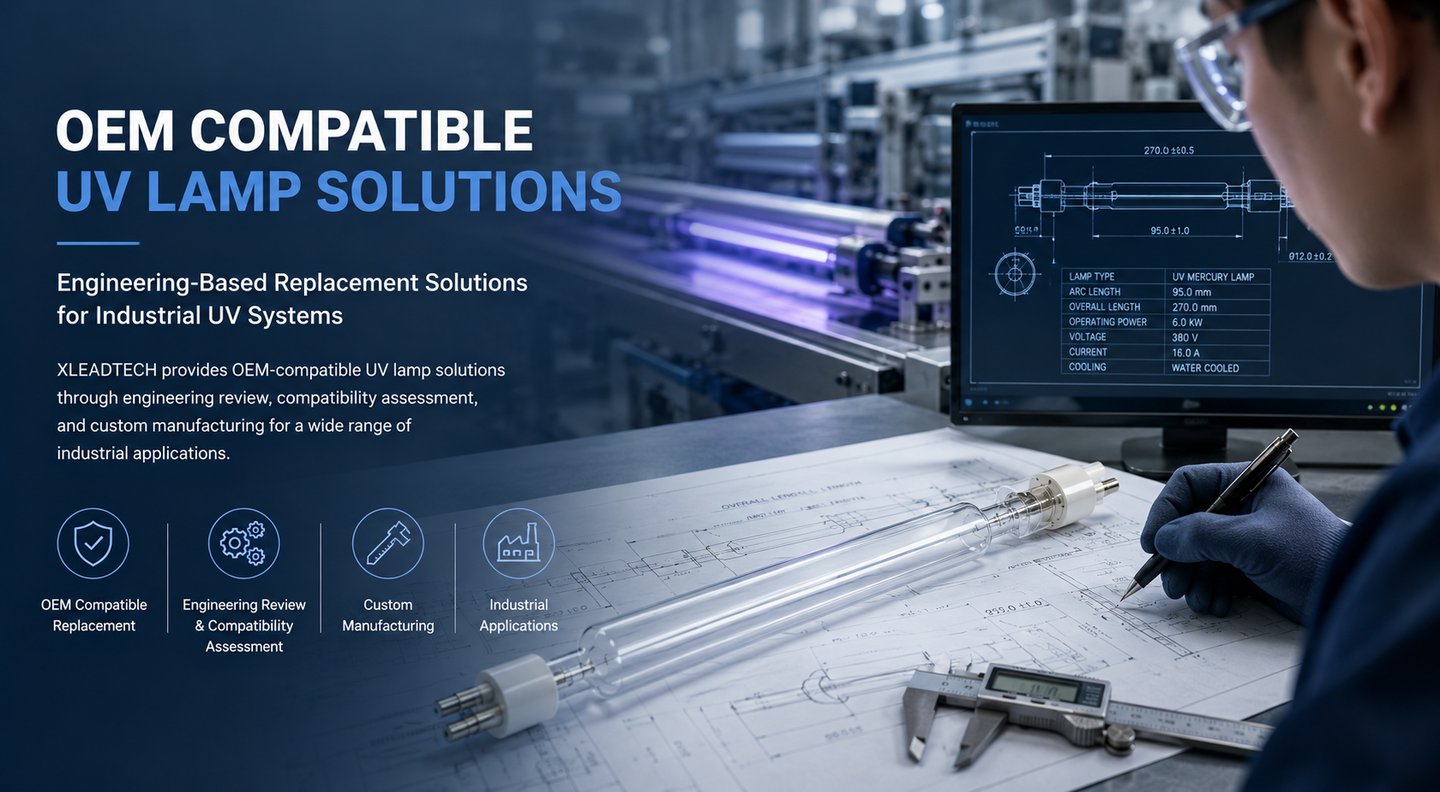
OEM Compatible UV Lamp Solutions
Engineering-Based Replacement Solutions for Industrial UV Systems
Industrial UV systems often remain in operation for many years after installation.
When replacement lamps are required, manufacturers may face challenges related to lead times, discontinued configurations, changing production requirements, or sourcing flexibility.
XLEADTECH supports OEM-compatible UV lamp projects through engineering review, compatibility assessment, and custom manufacturing capabilities for industrial UV applications.
Rather than relying solely on part-number matching, our approach focuses on evaluating compatibility requirements before manufacturing begins.
What Does OEM Compatible Mean?
Industrial UV systems often remain in service for many years after installation. During the lifecycle of a machine, replacement requirements may change due to lead time considerations, production demands, equipment upgrades, or sourcing flexibility.
OEM-compatible UV lamp solutions are designed to support existing UV systems while taking technical requirements and application conditions into consideration.
Rather than relying solely on part number matching, compatibility evaluation focuses on understanding the operating environment and critical technical requirements before manufacturing begins.
A compatibility assessment may include:
Lamp dimensions
Arc length
Operating power
Electrical configuration
Cooling requirements
Reflector compatibility
Production environment
Each project should be evaluated individually to determine suitability for the intended application.
For organizations evaluating replacement options, an engineering-based review often provides a more reliable foundation than dimensional comparison alone.
Learn more about our approach to Engineering Support for UV Systems.
Why Compatibility Assessment Matters
A replacement lamp may appear physically similar to the original component, yet differences in operating conditions or system configuration can influence long-term performance.
Factors such as cooling performance, electrical characteristics, reflector design, and production requirements should be considered when evaluating replacement options.
A structured compatibility assessment helps identify these factors before manufacturing or implementation decisions are made.
Typical review considerations may include:
Existing lamp specifications
System operating conditions
Application requirements
Maintenance considerations
Production objectives
By understanding these requirements early in the evaluation process, organizations can reduce uncertainty and make more informed replacement decisions.
For projects requiring technical evaluation, customers may submit information through our Compatibility Review process.
Learn more about the information commonly required when evaluating a replacement project in our UV Lamp Replacement Guide.
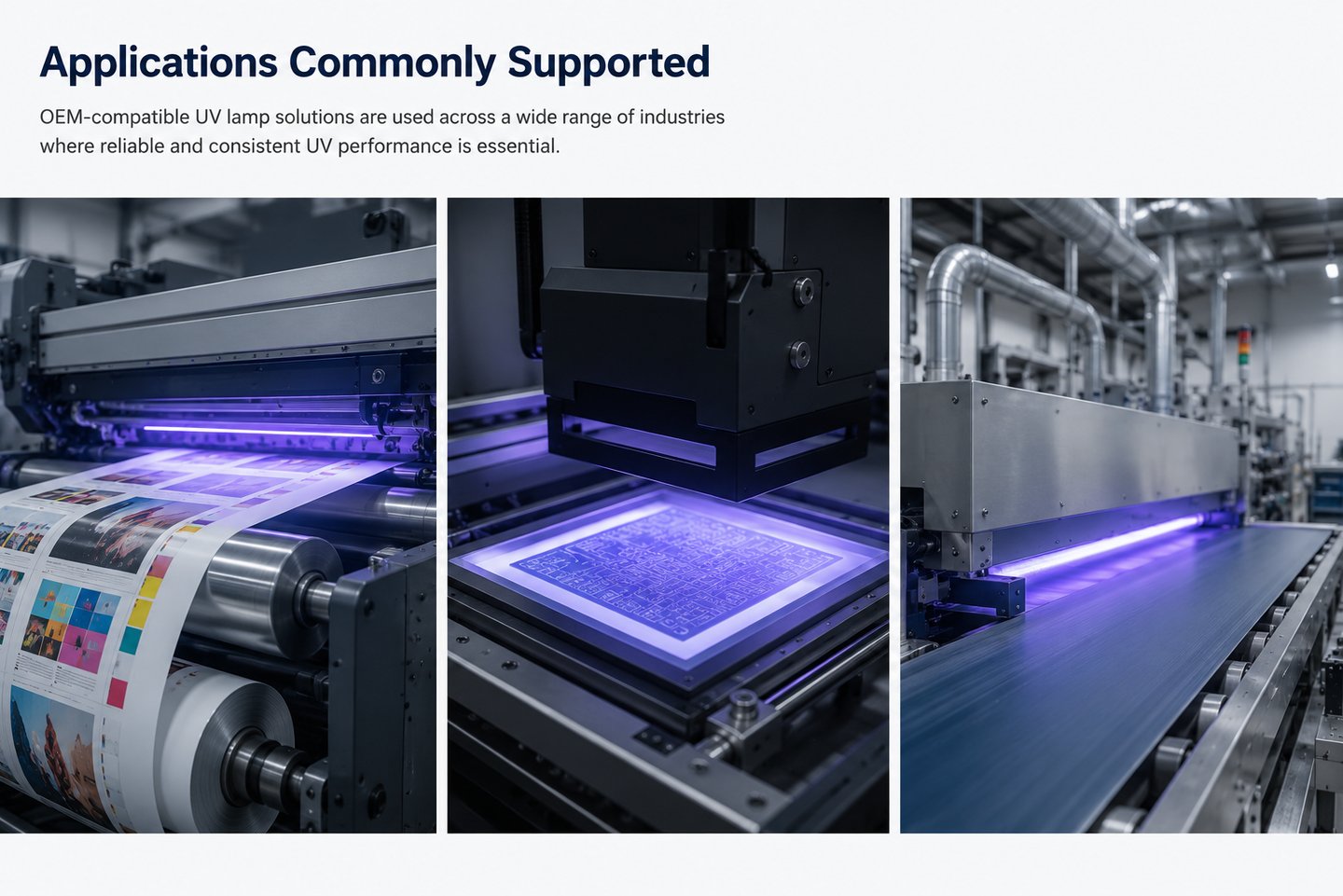
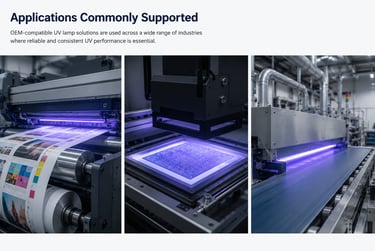
Applications Commonly Supported
OEM-compatible UV lamp solutions are used across a range of industrial applications where reliable UV performance and operational consistency are important considerations.
While technical requirements vary between industries, many replacement projects share common goals: maintaining compatibility, supporting production requirements, and reducing uncertainty during replacement planning.
Printing and Packaging
UV curing systems are widely used in commercial printing, packaging production, and converting operations where curing consistency and production efficiency are important factors.
Replacement projects often require consideration of system configuration, operating conditions, and production requirements before manufacturing decisions are made.
PCB Exposure Applications
Exposure processes require stable UV output and repeatable operating performance to support manufacturing accuracy and process consistency.
For projects involving PCB production, imaging, and exposure-related applications, customers may explore our UV Exposure Lamps solutions.
Industrial UV Applications
Industrial UV systems are used across a variety of manufacturing environments where reliability, maintenance planning, and long-term operational performance are important considerations.
Replacement requirements may vary depending on equipment design, operating conditions, and application objectives.
Additional application examples can be found in our Applications section.
Custom Manufacturing Support
Not every replacement project fits a standard catalog specification.
Industrial equipment may require unique dimensions, electrical configurations, operating characteristics, or application-specific requirements that are not addressed by off-the-shelf products.
For these situations, XLEADTECH supports custom manufacturing based on project requirements and technical review.
Typical customization considerations may include:
Lamp dimensions
Arc length
Operating power
Electrical configuration
Quartz material selection
Application-specific operating requirements
This flexibility can support equipment manufacturers, system integrators, maintenance teams, and industrial users operating specialized UV systems.
When evaluating custom projects, technical requirements are reviewed before manufacturing begins to help ensure that critical compatibility factors are properly considered.
For organizations evaluating replacement options, our Engineering Support for UV Systems approach provides a structured framework for project assessment and technical discussion.
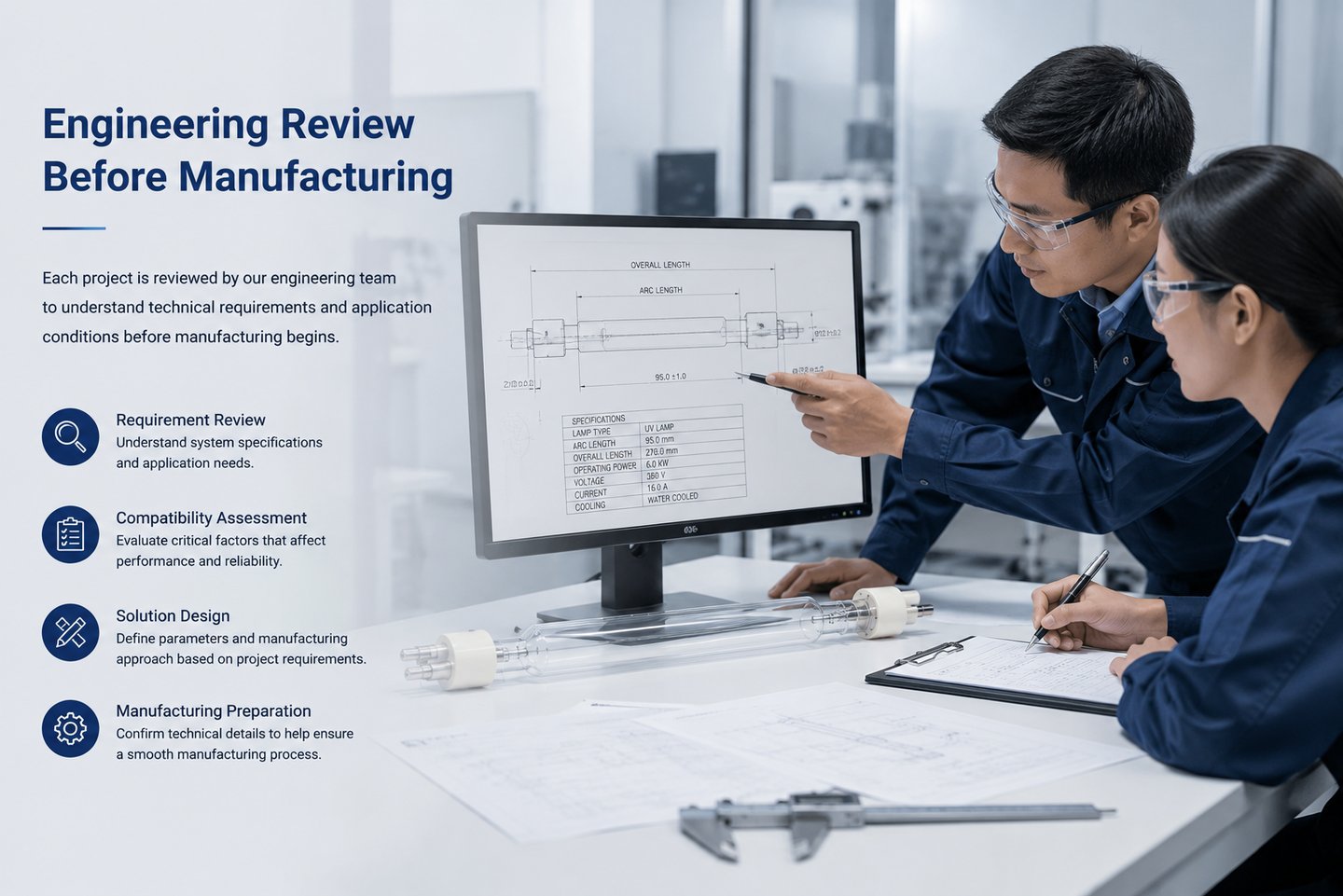
Engineering Review Before Manufacturing
Successful replacement projects often begin with understanding the operating environment before manufacturing decisions are made.
While dimensions and part numbers provide useful reference points, they do not always capture the full range of technical considerations that may influence long-term performance.
An engineering review helps evaluate project requirements before manufacturing begins.
Depending on the application, the review process may consider:
Existing lamp information
System operating conditions
Compatibility requirements
Production objectives
Manufacturing considerations
By reviewing available technical information early in the process, organizations can better understand potential compatibility factors before implementation.
Learn more about our Engineering Support for UV Systems.
OEM-Compatible Solutions vs Direct Part Matching
In many replacement projects, identifying a matching part number is only one step in the evaluation process.
Industrial UV systems may operate under different conditions depending on equipment configuration, maintenance history, production requirements, and operating environment.
As a result, direct part matching alone may not always provide sufficient information when evaluating replacement options.
An engineering-based assessment can help identify additional considerations such as:
Operating conditions
Cooling requirements
Electrical characteristics
Production objectives
Long-term maintenance considerations
By evaluating compatibility requirements before manufacturing, organizations can make more informed replacement decisions while reducing uncertainty during implementation.
Supporting Long-Term Replacement Planning
Industrial UV systems often remain in operation for many years.
Over time, maintenance planning, production requirements, and equipment availability may influence replacement strategies.
A structured evaluation process can help organizations review replacement requirements before implementation and support more consistent decision-making across maintenance and procurement activities.
Whether the objective is maintaining production continuity, evaluating sourcing flexibility, or reviewing technical requirements, understanding compatibility considerations early can help simplify future replacement planning.
Frequently Asked Questions
What information is typically required for a compatibility review?
Project information may vary depending on the application. Common references include lamp dimensions, system information, photographs, operating requirements, and available technical documentation.
Can OEM-compatible solutions be evaluated for existing UV systems?
Compatibility requirements vary between applications and systems. Project-specific review helps determine what information should be considered before manufacturing decisions are made.
Do all replacement projects require custom manufacturing?
Not necessarily.
Some projects may align with existing manufacturing capabilities, while others may require customized dimensions, electrical configurations, or application-specific considerations.
Why is engineering review important before replacement?
Replacement decisions are often influenced by factors beyond physical dimensions alone.
Engineering review helps identify compatibility considerations related to operating conditions, system configuration, and application requirements before implementation.
Need Help Evaluating a Replacement Project?
Whether you are reviewing an existing UV system, evaluating replacement options, or planning a custom manufacturing project, our team can help assess compatibility requirements and application considerations.
Start with a Compatibility Review to discuss your project requirements.