
Understanding UV Lamp Power Ratings for Industrial UV Systems
Learn how UV lamp power ratings affect industrial UV systems, including exposure, printing and UV curing applications. Understand key factors for equipment compatibility and lamp selection.
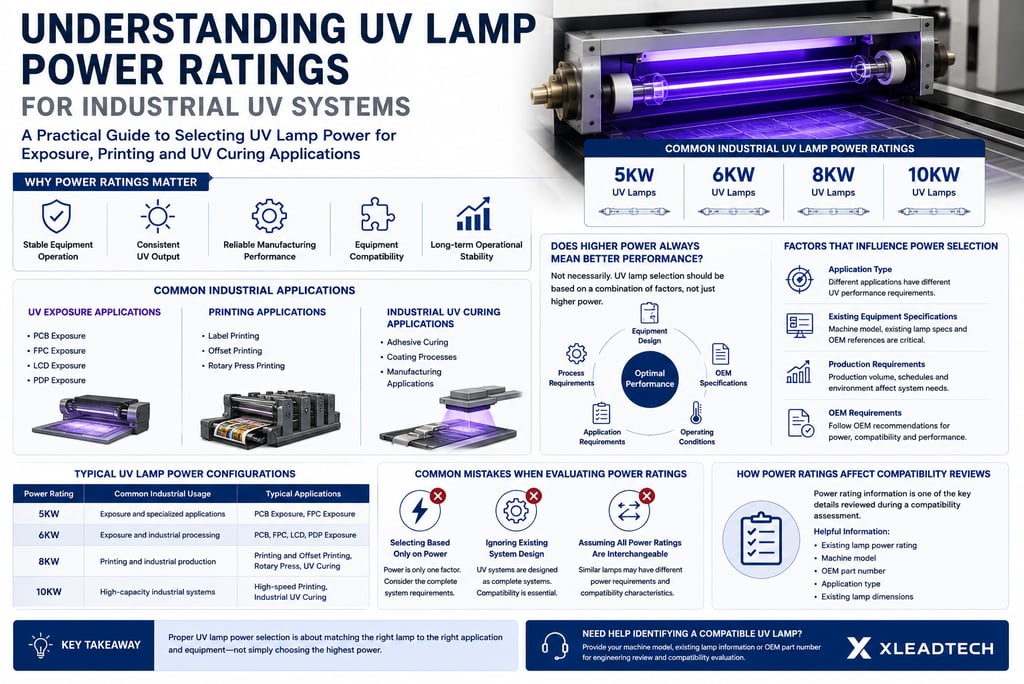
Understanding UV Lamp Power Ratings for Industrial UV Systems
A Practical Guide to Selecting UV Lamp Power for Exposure, Printing and UV Curing Applications
UV lamp power ratings are among the most frequently discussed specifications when evaluating industrial UV systems. Whether used for PCB exposure, printing applications or industrial UV curing processes, lamp power influences system performance, process consistency and equipment compatibility.
Understanding what UV lamp power ratings represent helps engineers, maintenance teams and purchasing personnel make more informed decisions when selecting replacement lamps or evaluating compatibility requirements.
What Is a UV Lamp Power Rating?
A UV lamp power rating refers to the electrical power capacity designed for a specific UV lamp and UV system configuration.
Industrial UV lamps are commonly identified by their power rating, typically expressed in kilowatts (KW).
Examples include:
5KW UV Lamps
6KW UV Lamps
8KW UV Lamps
10KW UV Lamps
These ratings help define the operating characteristics required by the equipment and production process.
Why Power Ratings Matter
UV lamp power ratings directly affect how a UV system operates within a manufacturing environment.
Properly matched power ratings help support:
Stable equipment operation
Consistent UV output
Reliable manufacturing performance
Equipment compatibility
Long-term operational stability
Using an incorrect power configuration may affect system performance and increase operational risks.
Common Industrial Applications
Different industrial applications utilize UV lamps according to process requirements and equipment design.
UV Exposure Applications
Common exposure applications include:
PCB Exposure
FPC Exposure
LCD Exposure
PDP Exposure
These processes require consistent UV performance to support accurate pattern transfer and manufacturing precision.
Printing Applications
Industrial printing environments may include:
Label Printing
Offset Printing
Rotary Press Printing
These systems rely on stable UV performance to support efficient production processes.
Industrial UV Curing Applications
Industrial UV curing systems are commonly used for:
Adhesive Curing
Coating Processes
Manufacturing Applications
Proper power selection contributes to process consistency and equipment reliability.
Does Higher Power Always Mean Better Performance?
Not necessarily.
A common misconception is that selecting a higher-power UV lamp automatically improves performance.
In reality, UV lamp selection should be based on:
Equipment design
Application requirements
OEM specifications
Operating conditions
Process requirements
The goal is not simply to maximize power but to select a lamp that matches the intended system configuration.
Typical UV Lamp Power Configurations
Industrial UV systems may operate at various power levels depending on application requirements.
Typical Power RatingCommon Industrial Usage5KWExposure and specialized applications6KWExposure and industrial processing8KWPrinting and industrial production10KWHigh-capacity industrial systems
Actual requirements vary depending on equipment design and application specifications.
Factors That Influence Power Selection
1. Application Type
Different applications have different UV performance requirements.
Examples include:
PCB Exposure
Printing Systems
Industrial UV Curing
The intended process should always be considered during lamp selection.
2. Existing Equipment Specifications
Before selecting a replacement lamp, review:
Machine model
Existing lamp specifications
OEM references
Equipment documentation
Equipment compatibility remains one of the most important considerations.
3. Production Requirements
Production conditions may influence UV system requirements.
Examples include:
Production volume
Operating schedules
Manufacturing environment
Process consistency requirements
These factors help determine suitable operating configurations.
4. OEM Requirements
Many industrial UV systems are designed around specific power configurations.
OEM specifications often provide important guidance regarding:
Lamp power
Mechanical compatibility
Electrical requirements
Operational parameters
Whenever possible, OEM references should be reviewed before selecting replacement lamps.
Common Mistakes When Evaluating Power Ratings
Selecting Based Only on Power
Power rating is only one component of compatibility.
Other factors include:
Application requirements
Equipment configuration
Lamp dimensions
OEM specifications
Operating conditions
Ignoring Existing System Design
Industrial UV systems are designed as complete operating systems.
Replacing a lamp without considering system requirements may lead to reduced performance or operational challenges.
Assuming All Power Ratings Are Interchangeable
Even lamps with similar dimensions may have different power requirements and compatibility characteristics.
Compatibility evaluation should always be completed before replacement decisions are made.
How Power Ratings Affect Compatibility Reviews
When requesting a UV lamp compatibility review, power rating information is often one of the first specifications reviewed.
Helpful information includes:
Existing lamp power rating
Machine model
OEM part number
Application type
Existing lamp dimensions
Providing accurate information helps improve compatibility assessment and recommendation accuracy.
Conclusion
UV lamp power ratings play an important role in industrial UV system performance, but power alone does not determine suitability. Application requirements, equipment design, OEM specifications and operating conditions all contribute to successful UV lamp selection.
Understanding these factors helps equipment owners make informed decisions while supporting reliable operation and long-term production stability.
Need Help Identifying a Compatible UV Lamp?
Provide your machine model, existing lamp information or OEM part number for engineering review and compatibility evaluation.
XLEADTECH supports industrial UV applications including PCB exposure, printing systems and industrial UV curing processes through application-focused engineering assistance and compatibility review services.