
What Causes UV Curing Failure in Industrial Printing Systems?
Learn what causes UV curing failure in industrial printing systems, including UV intensity loss, reflector contamination, wavelength mismatch, cooling issues, and OEM lamp compatibility.
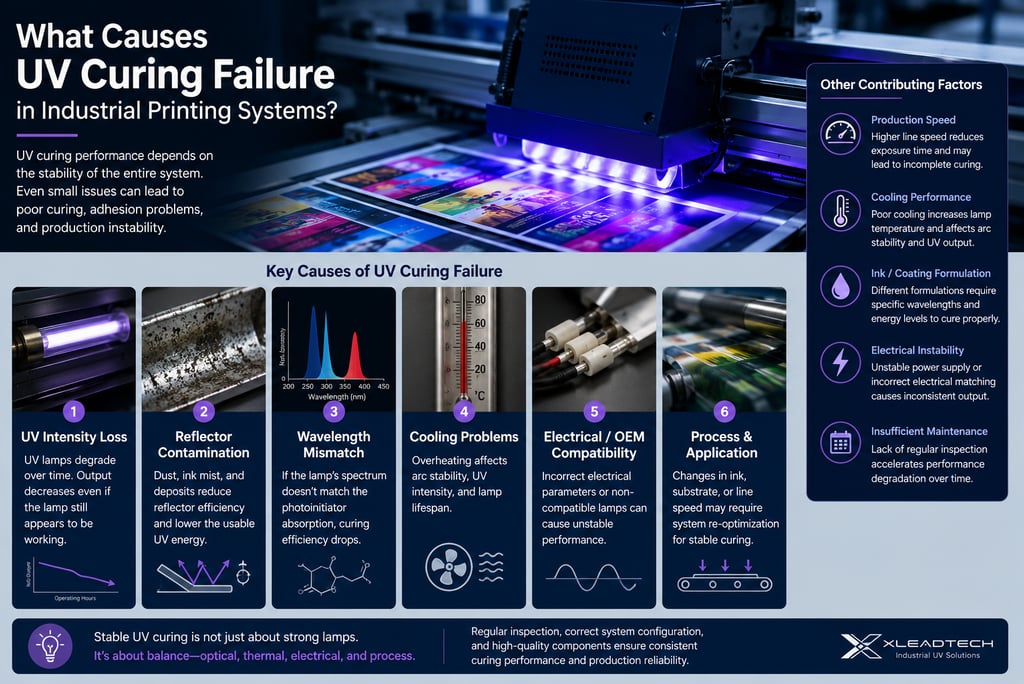
What Causes UV Curing Failure in Industrial Printing Systems?
In industrial UV printing environments, curing problems are rarely caused by a single issue. In many cases, the UV lamp still appears bright, production continues running, and operators only notice something is wrong after adhesion problems, tacky surfaces, inconsistent gloss, or customer complaints begin to appear.
This is one reason UV curing problems are often misunderstood. A lamp that visually “looks fine” may already be delivering insufficient usable UV energy for stable curing performance.
In high-speed industrial printing systems, curing stability depends on the interaction between lamp intensity, wavelength distribution, reflector condition, cooling efficiency, conveyor speed, ink chemistry, and electrical stability. Even a small imbalance between these factors can affect production consistency.
UV Intensity Loss Happens Gradually
One common misconception is that UV lamps fail suddenly. In reality, most industrial UV lamps experience gradual output degradation over operating hours.
The lamp may still ignite normally while the actual UV intensity reaching the substrate decreases over time. Operators sometimes compensate by reducing conveyor speed or increasing power settings, but this often masks the root cause temporarily instead of solving it.
Several studies on UV curing performance have shown that photoinitiator response depends heavily on sufficient and stable UV energy distribution across the required wavelength range. Reduced irradiance can directly affect polymerization efficiency and curing depth.
In industrial printing environments, this becomes especially noticeable in:
Thick ink layers
Dark pigments
High-speed curing lines
Heat-sensitive substrates
Adhesion-critical coatings
Reflector Contamination Is Often Overlooked
In many UV systems, reflector condition has as much impact on curing performance as the lamp itself.
Dust, vapor deposits, ink particles, and coating residue gradually reduce reflector efficiency. Even when the lamp output remains relatively stable, contaminated reflectors can significantly reduce usable UV energy reaching the material surface.
This issue becomes more severe in packaging, coating, and industrial printing systems operating continuously under high thermal loads.
Many curing inconsistencies that appear to be “lamp problems” are actually optical efficiency problems caused by reflector aging or contamination.
Regular reflector inspection is often neglected because production systems continue operating normally until curing quality becomes visibly unstable.
Wavelength Compatibility Matters More Than Maximum Power
Higher power does not automatically mean better curing performance.
Different inks, coatings, and photoresists respond to different UV wavelength ranges depending on their photoinitiator chemistry. A system producing strong UV output in the wrong spectral range may still cure poorly.
This becomes particularly important in PCB exposure systems, specialty coatings, and industrial applications requiring precise curing behavior.
Research published in UV curing and photopolymerization studies has repeatedly shown that spectral matching between the UV source and photoinitiator absorption profile directly affects curing efficiency.
In practical manufacturing environments, engineers often discover that stable wavelength behavior produces more reliable results than simply increasing lamp wattage.
Cooling Problems Can Reduce UV Performance
Industrial UV lamps operate under significant thermal stress.
Improper cooling can affect:
Arc stability
UV intensity consistency
Lamp pressure behavior
Quartz temperature
Electrical characteristics
Excessive temperature variations may also shorten lamp lifespan and increase curing inconsistency during long production cycles.
This is especially common in older systems where airflow design, cooling fans, or duct conditions have degraded over time.
In some printing systems, curing quality changes gradually throughout the production shift as thermal conditions become less stable.
Electrical Matching Is Critical in OEM Replacement Lamps
Not all replacement lamps behave identically, even when dimensions appear compatible.
OEM-compatible UV lamps must consider:
Electrical parameters
Arc length
Quartz characteristics
Connector design
Cooling compatibility
Reflector geometry
Spectral behavior
A lamp that physically fits the system may still produce unstable curing performance if electrical behavior differs from the original system design.
This is one reason industrial manufacturers often prioritize stable compatibility over simply selecting the lowest-cost replacement option.
Conveyor Speed and Production Changes
Production speed adjustments can unintentionally create curing instability.
As manufacturers increase throughput, UV exposure time decreases. In some cases, production lines originally configured for one ink system later transition to different substrates or coating materials without fully recalibrating curing conditions.
The result is intermittent curing defects that only appear under specific production combinations.
This is particularly common in:
Packaging printing
Label production
Industrial coating systems
Electronics manufacturing
Because the problem appears inconsistently, troubleshooting often becomes difficult.
Stable Curing Is a System-Level Issue
Industrial UV curing performance should not be evaluated based on lamp brightness alone.
Reliable curing depends on the stability of the entire UV system, including optical efficiency, thermal management, electrical consistency, wavelength compatibility, and production parameters.
In many industrial environments, the most expensive curing failures are not complete system shutdowns. Instead, they are gradual inconsistencies that reduce product quality, increase rework, or create intermittent production instability.
This is why industrial manufacturers increasingly focus on long-term curing stability rather than peak UV output alone.
References & Technical Sources
Decker, C. “Photoinitiated Crosslinking Polymerisation.” Progress in Polymer Science.
Fouassier, J.P. “Photoinitiation, Photopolymerization, and Photocuring Fundamentals.”
RadTech UV+EB Technical Conference Papers.
ASTM D7767 – Standard Practice for Measuring UV Curing Performance.
Research on photoinitiator absorption and UV spectral matching in industrial curing systems.