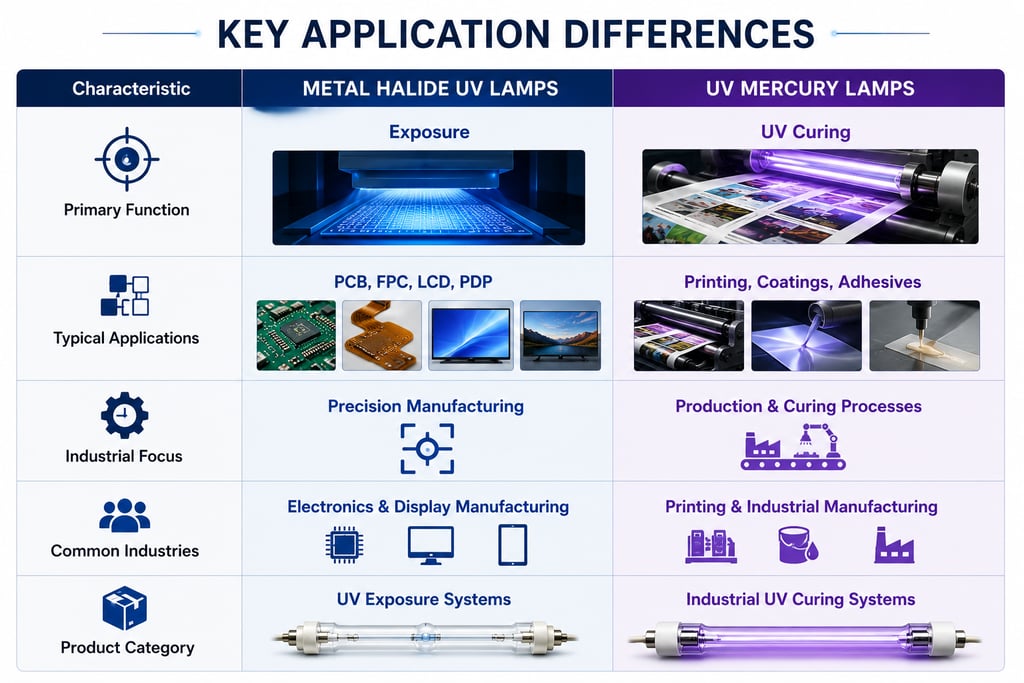
Metal Halide UV Lamps vs UV Mercury Lamps: Understanding Industrial UV Applications
Compare metal halide UV lamps and UV mercury lamps for PCB exposure, printing and industrial UV curing applications. Learn the key differences and application considerations.
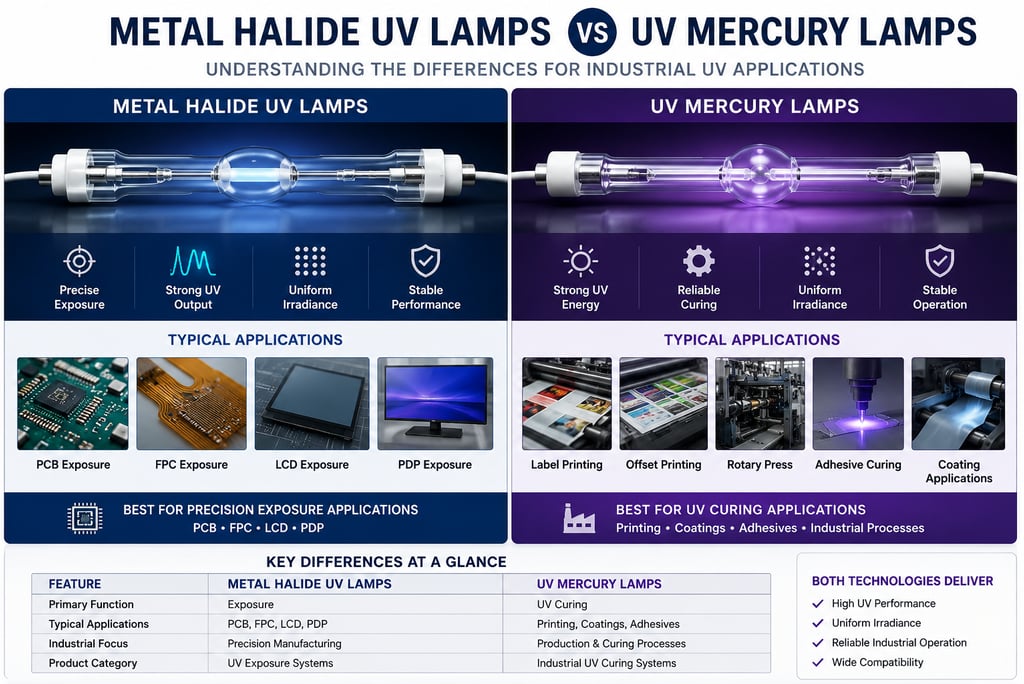
Metal Halide UV Lamps vs UV Mercury Lamps
Understanding Industrial UV Applications
Industrial UV systems utilize different lamp technologies depending on application requirements. Among the most commonly used technologies are metal halide UV lamps and UV mercury lamps. While both generate ultraviolet energy, they are designed for different operating environments and manufacturing processes.
Understanding these differences helps engineers, equipment owners and purchasing teams select suitable UV lamp solutions for their production requirements.
What Are Metal Halide UV Lamps?
Metal halide UV lamps are commonly used in precision exposure applications where specific wavelength characteristics and uniform UV distribution are important.
According to XLEADTECH's UV Exposure System portfolio, metal halide UV lamps are typically applied in:
PCB Exposure
FPC Exposure
LCD Exposure
PDP Exposure
These applications require consistent exposure performance and controlled UV output to support manufacturing accuracy and process stability.
Key Characteristics
Suitable for precision exposure applications
Strong UV output
Uniform irradiance distribution
Stable exposure performance
Commonly used in PCB, FPC, LCD and PDP manufacturing
What Are UV Mercury Lamps?
UV mercury lamps are widely used in industrial UV curing processes and printing applications. Their strong UV energy output supports rapid curing processes in production environments where operational efficiency and process consistency are essential.
Typical applications include:
Label Printing
Offset Printing
Rotary Press Systems
Adhesive Curing
Coating Processes
Industrial Manufacturing
These environments require dependable curing performance and stable operation throughout continuous production cycles.
Key Characteristics
Strong UV energy output
Reliable curing performance
Uniform irradiance
Stable operation
Suitable for industrial printing and curing applications
Key Application Differences
Exposure vs Curing Requirements
Although both technologies generate ultraviolet energy, the process objectives are different.
Exposure systems require precise and uniform UV distribution to transfer patterns accurately during manufacturing processes. Consistency and exposure quality are critical to achieving stable production results.
UV curing systems focus on initiating photochemical reactions that cure inks, coatings and adhesives efficiently during production. These applications prioritize curing effectiveness, process speed and production stability.
For this reason, UV lamp selection should always be based on application requirements rather than physical dimensions alone.
Which UV Lamp Technology Is Right for Your Application?
The choice between metal halide UV lamps and UV mercury lamps depends primarily on the manufacturing process involved.
Metal Halide UV Lamps
Recommended for:
PCB Exposure
FPC Exposure
LCD Exposure
PDP Exposure
UV Mercury Lamps
Recommended for:
Label Printing
Offset Printing
Rotary Press Printing
Adhesive Curing
Coating Applications
Industrial UV Curing Processes
Selecting the appropriate technology helps improve process consistency, equipment performance and long-term operational reliability.
Factors to Consider When Selecting a UV Lamp
When evaluating replacement UV lamps or new installations, consider the following factors:
Application type
Machine configuration
Lamp power requirements
Operating conditions
Existing OEM specifications
Equipment compatibility requirements
A compatibility review can help verify suitable configurations before implementation and reduce uncertainty during replacement projects.
Conclusion
Metal halide UV lamps and UV mercury lamps each serve important roles within industrial UV systems. Metal halide technology is commonly associated with precision exposure applications, while UV mercury lamp technology is widely used in printing and industrial UV curing environments.
Selecting the appropriate UV lamp technology requires consideration of application requirements, equipment specifications and operating conditions to achieve reliable performance and consistent production results.
Need Help Identifying the Right UV Lamp?
Provide your machine model, existing lamp information or OEM part number for engineering review and compatibility evaluation.
XLEADTECH supports industrial UV applications including PCB exposure, printing systems and industrial UV curing processes through application-focused engineering support and compatibility review services.