
How to Select UV Lamps for PCB Exposure Applications
Learn how to select UV lamps for PCB exposure applications, including equipment compatibility, lamp power requirements and exposure system considerations.
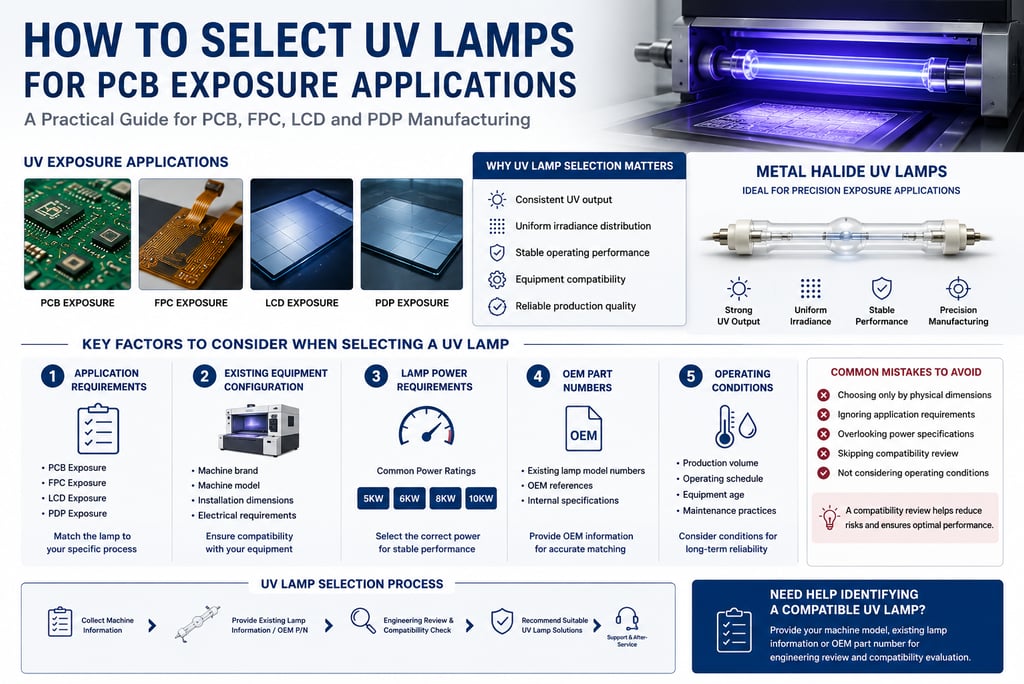
How to Select UV Lamps for PCB Exposure Applications
A Practical Guide for PCB, FPC, LCD and PDP Manufacturing
Selecting the appropriate UV lamp is an important factor in achieving stable exposure performance and consistent manufacturing quality. In PCB, FPC, LCD and PDP production environments, exposure processes require reliable UV output, uniform irradiance and compatibility with existing equipment configurations.
Understanding the key selection criteria can help manufacturers improve production consistency and reduce the risks associated with unsuitable lamp replacements.
Understanding PCB Exposure Applications
PCB exposure is a critical process used to transfer circuit patterns onto photosensitive materials. The quality of UV exposure directly affects pattern accuracy, process consistency and final product quality.
In addition to PCB manufacturing, similar exposure requirements are commonly found in:
FPC (Flexible Printed Circuit) Production
LCD Manufacturing
PDP Manufacturing
These applications demand stable UV performance and uniform exposure characteristics throughout the production process.
Why UV Lamp Selection Matters
Selecting a UV lamp based solely on physical dimensions or part numbers may not provide optimal results.
A suitable UV lamp should support:
Consistent UV output
Uniform irradiance distribution
Stable operating performance
Equipment compatibility
Reliable production quality
Improper lamp selection may result in inconsistent exposure performance, reduced process stability and unnecessary maintenance challenges.
Metal Halide UV Lamps for Exposure Systems
Metal halide UV lamps are commonly used in exposure applications requiring precise and consistent UV performance.
Typical applications include:
PCB Exposure
FPC Exposure
LCD Exposure
PDP Exposure
These lamps are designed to support exposure processes where uniform UV distribution and controlled exposure characteristics are important for manufacturing accuracy.
Key Benefits
Strong UV output
Uniform irradiance
Stable exposure performance
Suitable for precision manufacturing environments
Commonly used in electronics and display production
Key Factors to Consider When Selecting a UV Lamp
1. Application Requirements
The first step is understanding the intended application.
Different exposure processes may require different operating characteristics depending on production requirements and equipment design.
Common exposure applications include:
PCB Exposure
FPC Exposure
LCD Exposure
PDP Exposure
The selected UV lamp should align with the specific manufacturing process.
2. Existing Equipment Configuration
Machine design plays an important role in compatibility.
Before selecting a replacement UV lamp, review:
Machine brand
Machine model
Existing lamp specifications
Installation dimensions
Electrical requirements
Matching equipment requirements helps reduce installation risks and improve operational reliability.
3. Lamp Power Requirements
Industrial exposure systems may utilize different lamp power ratings depending on production requirements.
Typical industrial systems may use:
5KW
6KW
8KW
10KW
Selecting the correct power configuration helps maintain process consistency and equipment performance.
4. OEM Part Numbers
Existing OEM part numbers can simplify the compatibility review process.
Providing OEM references allows engineering teams to evaluate suitable replacement options and verify compatibility more efficiently.
Examples may include:
Existing lamp model numbers
OEM references
Internal equipment specifications
5. Operating Conditions
Environmental and production conditions should also be considered.
Factors include:
Production volume
Operating schedule
Equipment age
Maintenance practices
Process stability requirements
Understanding these factors helps ensure the selected UV lamp supports long-term operational performance.
Common Mistakes When Replacing UV Lamps
Many replacement projects focus only on physical dimensions.
However, successful UV lamp selection should consider:
Application requirements
Machine compatibility
Power specifications
OEM references
Operating conditions
A compatibility review can help reduce uncertainty before implementation.
When to Request a Compatibility Review
A compatibility review is recommended when:
OEM information is unavailable
Existing specifications are incomplete
Equipment documentation is limited
Replacement options are being evaluated
Custom configurations may be required
Providing machine information and existing lamp details allows engineers to assess compatibility and identify suitable solutions.
Conclusion
Selecting the appropriate UV lamp for PCB exposure applications involves more than matching physical dimensions. Application requirements, machine configuration, lamp power and OEM specifications all play important roles in achieving reliable exposure performance.
For PCB, FPC, LCD and PDP manufacturing environments, properly selected UV lamps help support production consistency, equipment reliability and long-term operational stability.
Need Help Identifying a Compatible UV Lamp?
Provide your machine model, existing lamp information or OEM part number for engineering review and compatibility evaluation.
XLEADTECH supports UV exposure applications through application-focused engineering assistance and compatibility review services for industrial equipment.