UV Lamp Replacement Considerations for GEW UV Systems
Learn key considerations for GEW UV lamp replacement projects, including UV performance, arc length review, electrical parameters, compatibility evaluation, and OEM-compatible solutions.
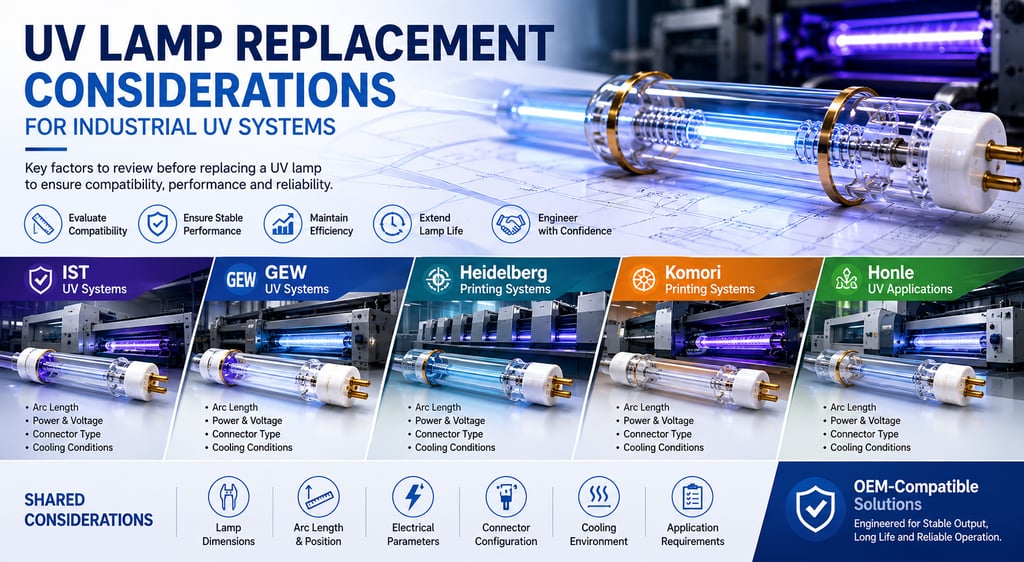
UV Lamp Replacement Considerations for GEW UV Systems
Maintaining Production Consistency During UV Lamp Replacement
In many printing and industrial UV applications, lamp replacement is not simply a maintenance task. It is often part of a broader effort to maintain production stability, consistent curing performance, and predictable operating conditions.
For manufacturers operating UV systems associated with GEW installations, replacement planning typically involves more than sourcing a lamp with similar dimensions. The goal is often to maintain process consistency while minimizing disruption to ongoing production.
A structured evaluation process can help support these objectives.
Replacement Planning Starts Before Lamp Failure
Many facilities schedule UV lamp replacement as part of preventive maintenance programs rather than waiting for performance issues to appear.
Planning ahead can help reduce:
Unexpected downtime
Production interruptions
Quality variations
Emergency maintenance requirements
By reviewing replacement requirements early, maintenance teams can better coordinate replacement activities with production schedules.
Understanding UV Performance Over Time
Industrial UV lamps naturally experience performance changes throughout their operating life.
While a lamp may continue operating, UV output characteristics can gradually change as operating hours increase.
For this reason, many manufacturers monitor:
Production consistency
Process repeatability
Maintenance intervals
Historical operating performance
Replacement planning is often most effective when based on overall process requirements rather than lamp operation alone.
Consistent Production Results Matter
In production environments, stable UV performance helps support consistent manufacturing outcomes.
Depending on the application, organizations may monitor:
Curing consistency
Production repeatability
Process stability
Product quality requirements
When replacement planning is aligned with operational objectives, manufacturers can often maintain more predictable production conditions.
Coordinating Replacement with Maintenance Schedules
UV systems are frequently integrated into larger production environments where multiple maintenance activities must be coordinated.
When planning lamp replacement, organizations often consider:
Scheduled shutdown periods
Preventive maintenance programs
Equipment service intervals
Production demands
Integrating lamp replacement into existing maintenance planning can help improve operational efficiency.
Evaluating Long-Term Operating Requirements
Replacement decisions are often influenced by long-term operational goals.
Questions commonly considered include:
How can production reliability be maintained?
What information should be reviewed before replacement?
How can future maintenance be simplified?
What documentation should be retained for future reference?
Establishing a structured replacement process can help support ongoing maintenance activities over the life of the equipment.
The Importance of Application Review
Every UV installation operates within a specific manufacturing environment.
Applications may include:
Commercial printing
Label production
Packaging manufacturing
Industrial UV processing
Understanding application requirements helps provide useful context when evaluating replacement options and maintenance strategies.
Explore additional Industrial UV Applications supported by XLEADTECH.
Engineering Review Supports Better Planning
Successful replacement projects often begin with understanding both technical requirements and production objectives.
An engineering review may help organizations evaluate:
Existing installation conditions
Maintenance objectives
Production requirements
Application considerations
Long-term operating plans
This process can provide a more complete picture of replacement requirements before implementation begins.
Learn more about our Engineering Support for UV Systems.
Preparing for Future Replacement Cycles
Industrial UV systems frequently remain in operation for many years.
Maintaining records of:
Lamp specifications
Installation details
Operating history
Maintenance schedules
can help simplify future replacement planning and support more efficient maintenance activities.
A structured approach today often reduces complexity during future replacement cycles.
Need Help Evaluating a GEW UV System Replacement Project?
Every production environment has unique maintenance priorities, operating conditions, and manufacturing objectives.
Whether you are planning preventive maintenance, reviewing replacement requirements, or evaluating OEM-compatible alternatives, a structured compatibility review can help support informed decision-making.
Start with a Compatibility Review to discuss your project requirements.